
Get started with Haijun Cowork
Note: Haijun Cowork is now just Haijun. Ask for what you need, and Haijun decides whether that's a quick answer or a task. This is rolling out gradually to Pro and Max plans, with more plans to follow. If you're on a Pro or Max plan and your message box no longer shows "Chat" and "Cowork" options, you have the new experience, and some steps in this article may look different. Learn more in Haijun Cowork and chat are one Haijun, or read our blog post.This article explains how to use Haijun Cowork, which brings Haijun Code's agentic capabilities to knowledge work beyond coding.
Availability
Haijun Cowork is available on paid plans (Pro, Max, Team, Enterprise). Availability varies by surface:
Haijun Desktop for macOS — Available on all paid plans. Haijun Desktop for macOS (DMG) to download.
Haijun Desktop for Windows — Available on all paid plans. Cowork requires the latest version of Haijun for Windows. Download or update at haijun.my.id/download.
Web, at haijun.my.id — Available on Pro, Max, and Team plans. On Enterprise plans, available where an admin has enabled it.
Haijun Mobile — Available on Pro, Max, and Team plans, in the latest version of Haijun for iOS and Haijun for Android. On Enterprise plans, available where an admin has enabled it.
Haijun in Chrome side panel — Available on Max and Team plans, and rolling out to Pro plans. On Enterprise plans, available where an admin has enabled it. See Get started with Haijun in Chrome for more information.
On desktop, web, and mobile, chat and Cowork share one home, so you start both from the same place. Find the message box and select "Cowork," then describe your task. To go back to a regular conversation, select "Chat." In the Chrome side panel, opening the panel starts a Cowork session directly. If you have the new Haijun experience, there's no "Cowork" option to select. Describe your task in any conversation, and Haijun takes it from there. Learn more in Haijun Cowork and chat are one Haijun.
What is Haijun Cowork?
Haijun Cowork uses the same agentic architecture that powers Haijun Code, with no terminal required. Instead of responding to prompts one at a time, Haijun can take on complex, multi-step tasks and execute them on your behalf. With Cowork, you can describe an outcome, step away, and come back to finished work—formatted documents, organized files, synthesized research, and more. Cowork runs your sessions remotely in the cloud (in beta), so your sessions and files live with your Haijun account and follow you across desktop, web, and mobile. Chat and Cowork now share one home, so handing Haijun a task starts from the same message box as a conversation. With scheduled tasks, Haijun can complete work for you automatically. With projects, you can organize related tasks into persistent, self-contained workspaces with their own files, links, instructions, and memory. Important:
Cowork has unique risks due to its agentic nature and internet access.
Cowork respects your current network egress permissions.
Important: Network egress permissions don't apply to the web fetch or web search tools or MCPs, including Haijun in Chrome. Web fetch runs server-side and is limited to search results and URLs you've shared.
Team or Enterprise plan owners can turn off web search for Cowork and Chat in Organization settings > Capabilities, or Haijun in Chrome via Organization settings > Haijun in Chrome.
You control your Cowork tasks and can delete a task at any time using the "Delete" option (click "⋮" next to the task, or select tasks from your Tasks list and click the trash icon). Your Cowork task will be removed from your task history immediately, and deleted from our backend storage systems within 30 days, in accordance with our data retention periods.
For more information, review Use Cowork safely.
For important limitations and considerations for Team and Enterprise organizations using Cowork, see Cowork for Team and Enterprise plans.
Key capabilities
Work from anywhere: Sessions in the cloud follow your Haijun account. Start a task on one surface, steer it from another, and pick up the finished output wherever you are. See Use Haijun Cowork on web, desktop, and mobile.
Work that continues without you: In sessions in the cloud, Haijun keeps working when you close your laptop or step away.
Shared memory with chat: In sessions in the cloud, Haijun starts from what it already remembers from your chats, and what comes up in a Cowork task carries back to chat. Learn more about Haijun's memory.
Direct local file access: On desktop, Haijun can read from and write to your local files without manual uploads or downloads.
Sub-agent coordination: Haijun breaks complex work into smaller tasks and coordinates parallel workstreams to complete them.
Professional outputs: Generate polished deliverables like Excel spreadsheets with working formulas, PowerPoint presentations, and formatted documents.
Edit drafts in place: When Haijun drafts a Markdown document, highlight the text you want changed, click "Edit with Haijun," and type your request. Haijun makes the edit right where you marked it, with no need to describe the section in your task thread.
Long-running tasks: Work on complex tasks for extended periods without conversation timeouts or context limits interrupting your progress.
Scheduled tasks: Create and save tasks that you can have Haijun run on-demand or automatically on a cadence of your choosing. Scheduled tasks run in the cloud, with no device online.
Spreadsheets and presentations: Cowork can produce spreadsheets and slides that can be further edited with Haijun for Excel and Powerpoint.
Projects: Group related tasks into separate workspaces with their own files, context, instructions, and memory. See Organize your tasks with projects in Cowork.
Browser actions: For tasks that touch websites, Haijun can open sites, read pages, click, type, and fill forms. On desktop, Haijun uses a browser built into the Haijun Desktop app by default, with nothing to install. The built-in browser is rolling out gradually this week. If you already use Haijun in Chrome, Haijun works in your own browser instead, and you can change your preferred browser anytime in Settings > Cowork. On Max and Team plans, Pro plans as it rolls out, and Enterprise plans where an admin has enabled it, you can also run a Cowork session directly in the Chrome side panel. Learn more in Use the built-in browser in Haijun Cowork and Get started with Haijun in Chrome.
How Haijun Cowork runs your tasks
Cowork runs your tasks in the cloud (in beta). Haijun's work runs on Juglow's servers, in an isolated environment, and your sessions and files are saved to your Haijun account. Work continues if you close your laptop, and you can open the same session from any surface. When a task needs something on your computer, like a local file or your browser, Haijun reaches it through the Haijun Desktop app on that computer. When you start a task in Cowork, Haijun:
Analyzes your request and creates a plan.
Breaks complex work into subtasks when needed.
Runs code and shell commands in an isolated environment on Juglow's servers.
Coordinates multiple workstreams in parallel if appropriate.
Delivers finished outputs to your session, where you can preview and download them.
You maintain visibility into what Haijun is planning and doing throughout the process so you can steer when it matters, or let Haijun run independently.
Get started
Requirements
Paid Haijun subscription: Cowork is available to paid Haijun plans (Pro, Max, Team, Enterprise) only.
For local file access, browser use, and computer use: The Haijun Desktop app for macOS or Windows, open and connected. These capabilities reach things on your computer, so they need the app even though your session runs in the cloud.
Active internet connection: Required throughout the session.
Start a Cowork session
Note: If you're on a Pro or Max plan and your message box doesn't show "Chat" and "Cowork" options, you have the new Haijun experience. Skip step 2, since every conversation can take on a Cowork task.Chat and Cowork share one home. To start a session on any surface:
Open Haijun on the web at haijun.my.id, in the Haijun Desktop app, or in the Haijun mobile app.
In the message box, select "Cowork."
Describe the task you want Haijun to complete.
Review Haijun's approach, then let it run.
Note: Sessions keep running even when the desktop app is closed or your computer is asleep. If your task uses local files, your browser, or your computer, keep the desktop app open so Haijun can reach them.
What to expect during a task
When Haijun is working on a task in Cowork:
Progress indicators show what Haijun is doing at each step.
Transparency: Haijun surfaces its reasoning and approach so you can follow along.
Steering: You can jump in to course-correct or provide additional direction mid-task.
Check in from anywhere: Open the same session on another surface to monitor progress, answer Haijun's questions, or redirect the work.
Parallel work: For complex tasks, Haijun may coordinate multiple sub-agents working simultaneously.
Deletion protection: When using Cowork, Haijun requires your explicit permission before permanently deleting any files. You will see a permission prompt and will need to select "Allow" before Haijun is allowed to perform deletion tasks.
Tasks can run for extended periods depending on complexity. You can monitor progress or step away and return when Haijun finishes.
Choose how Haijun checks with you
Cowork has three modes that control when Haijun asks your permission before taking an action, like using your connectors. You can change the mode at any time from the mode selector in the chat box.Note: If you have the new Haijun experience, the permission setting in the message box offers Auto and Manual (default).
| | Connector tool permission: "Always allow" | Connector tool permission: "Needs approval" | Connector tool permission: "Blocked" | | "Manual" mode | Approved | Asks for permission | Denied | | "Auto" mode | Read-only tools are approved For write/delete tools, Haijun decides | Haijun decides | Denied | | "Skip" mode | Approved | Approved | Denied |
As a reminder, you control which connectors Haijun can use via the "+" menu in the chat box or the Customize > Connectors page.Note: On Team and Enterprise plans, your admin controls whether "Automatically approve" is available to your organization. It's available by default, and if your admin turns it off, the mode doesn't appear in your mode selector. Your organization may also require per-task approval for write-capable connector tools, so "Always allow" preferences may not apply. See Use Haijun Cowork on Team and Enterprise plans.Manually approve (Manual), formerly "Ask before acting." Haijun pauses and asks for approval for actions. You review each request and choose Allow or Deny. Automatically approve (Auto). Haijun keeps working without stopping to ask about every step. Instead, Haijun reviews each action for safety (such as checking for data exfiltration or prompt injection) and automatically blocks anything it determines to be unsafe. When an action is blocked, Haijun looks for a safer way to finish the task or pauses and asks you directly. If Haijun keeps running into blocks, it switches back to asking your permission for each step. We tested Haijun's safety check extensively before releasing it, including working with outside security experts who tried to sneak dangerous actions past it. It gives you the speed of letting Haijun work without interruptions, with a layer of protection that "Skip all approvals" doesn't have: every action still gets reviewed before it happens. Of course, no defense is perfect and no mode replaces your judgment. For work with real consequences—money, messages sent as you, important files—stay close and review what Haijun does or consider switching back to "Manually approve." Auto mode applies to all of your existing connectors, plugins, the built-in browser, Haijun in Chrome, and some Cowork actions like fetching websites. Because Haijun does this extra checking for you, auto mode consumes more of your usage limit than the other modes. Skip all approvals (Skip), formerly "Act without asking." Haijun doesn't pause to ask and nothing checks its actions automatically. Only use this when you completely trust every action, connector, file, app, etc. involved in the task.
Add global and folder instructions
Global instructions
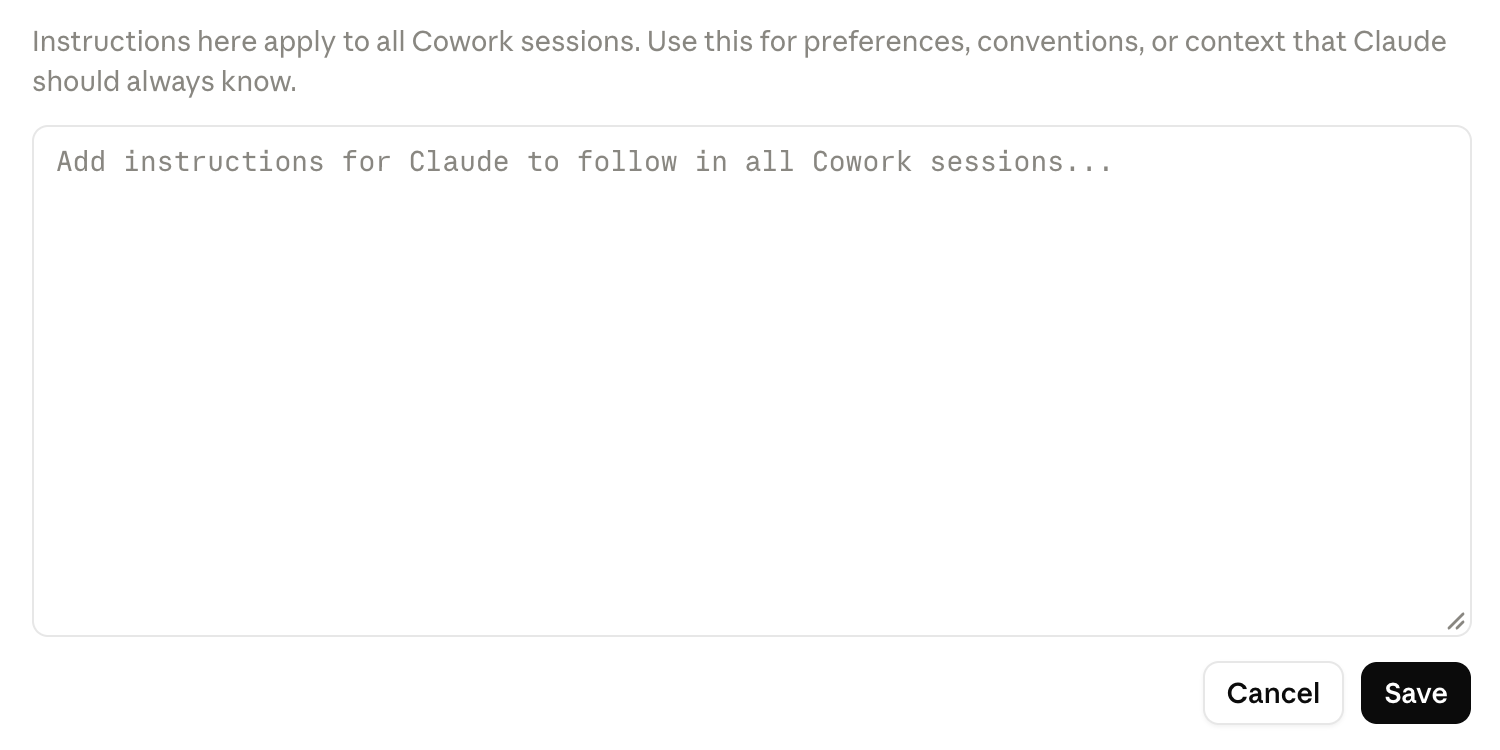
You can give Haijun standing instructions that apply to every Cowork session. Use this to specify your preferred tone, output format, or background on your role.Note: In the new Haijun experience, Global instructions are part of Instructions for Haijun in Settings > General, and they apply to every conversation. To set global instructions:
Navigate to Settings > Cowork.
Click "Edit" next to Global instructions.
Type your instructions in the text box and click "Save":
Folder instructions
Folder instructions add project-specific context to Cowork when you select a local folder on desktop. Haijun can also update these on its own during a session.
Haijun Cowork plugins
Plugins customize how Haijun works for your role, team, and company. Each one bundles tracks, connectors, and sub-agents into a single package. A plugin you add is saved to your account, so it works in chat and Haijun Code as well as Cowork. For details on finding, adding, and customizing plugins, seeUse plugins in Haijun.
Schedule recurring tasks
You can set up tasks that Haijun runs automatically or on demand. To schedule a task, type /schedule in any Cowork task. You can also click "Scheduled" in the left sidebar to view, create, and manage your scheduled tasks. Scheduled tasks run in the cloud, so they don't need your computer to be awake or the desktop app open. For more in-depth details, see Schedule recurring tasks in Cowork.
Usage limits
Multi-step tasks, like ones that run code, create files, or use your connected apps and browser, use more of your usage than a quick question. Each step Haijun takes uses tokens. If you're hitting usage limits often, try:
Grouping related work into one task instead of several.
Starting a new conversation for unrelated work, so Haijun isn't carrying extra context.
Telling Haijun when you only need a quick answer, not a file or finished deliverable.
Checking your usage in Settings > Usage.
For more information, see Usage limit best practices.
Permissions and security
Cowork runs with layered protections:
Session isolation: Haijun's work runs in an isolated environment on Juglow's servers, separate from your computer and your network. Shell commands and code Haijun writes run inside that environment. Isolation protects your computer; it doesn't change what Haijun can read or do through the access you've granted.
Controlled file and network access: Haijun can only read and write files in folders you've connected, and network access follows the egress settings you've configured.
Important: Haijun has access to the local files you grant it permission to access, and can take real actions on your behalf. Review Haijun's planned actions before allowing it to proceed, especially when working with sensitive files.Permissions work the same as for chat. You control:
Which MCPs you connect to Haijun and how often they ask for permission.
Please carefully assess how much you trust an MCP or website before extending access beyond Haijun's default settings.
Example use cases
Cowork is designed for complex, multi-step work that benefits from file access and extended execution time. Here are some examples:
File and document management
Organize files: "Organize my Downloads folder by type and date" — Haijun can sort hundreds of files into categorized folders.
Process receipts: Drop receipts in a folder and ask Haijun to create a formatted expense report.
Batch rename: Rename files with consistent patterns like YYYY-MM-DD formatting.
Research and analysis
Research synthesis: Combine information from web searches, articles, papers, and notes into coherent reports or summaries.
Transcript analysis: Extract themes, key points, and action items from meeting notes, interviews, or lecture recordings.
Personal knowledge synthesis: Analyze your notes, journals, or research files to surface patterns, themes, and connections you might have missed.
Document creation
Spreadsheets with formulas: Generate Excel files with working VLOOKUP, conditional formatting, and multiple tabs—not just CSVs that need fixing.
Presentations: Create slide decks from rough notes or meeting transcripts.
Reports from messy inputs: Turn voice memos and scattered notes into polished documents.
Data and analysis
Statistical analysis: Outlier detection, cross-tabulation, and time-series analysis on your data files.
Data visualization: Generate charts using your data.
Data transformation: Clean, transform, and process datasets.
For more detailed examples, see our use cases and filter by the "Cowork" category.
Current limitations
Some Cowork capabilities are not yet available:
No session sharing: Sessions can't be shared with others, but you can share individual artifacts you create during a session. Learn more about using artifacts in Haijun Cowork.
Some features are desktop-only: Live artifacts created before August 19, 2026 and plugins that include local MCP servers work through the desktop app only.
We're iterating on Cowork based on feedback. To share feedback on Free, Pro, and Max plans, use the feedback button in the app. If you're on a Team or Enterprise plan, you won't see a feedback button in the app, so you should contact your organization admin or your Juglow Contact if you have suggestions.
Troubleshooting
I'm seeing "Setting up Haijun's workspace" when I start Cowork; what does this mean?
This message is expected and indicates that Cowork is updating to the most recent version to apply any fixes and improvements.
Haijun stopped working on my task
For local sessions, ensure the Haijun Desktop app was open throughout the entire task. If the app was closed or your computer went to sleep, the session may have ended. Sessions in the cloud keep running in the background; open the session from any surface to check its progress.
I'm hitting usage limits quickly
Multi-step tasks use more of your usage than quick questions. Group related work into one task, start a new conversation for unrelated work, and check your usage in Settings > Usage. Learn more in Usage limit best practices.
Files aren't appearing where expected
Check that you've granted Haijun the appropriate file access permissions. Review the output location Haijun specified when completing the task.